
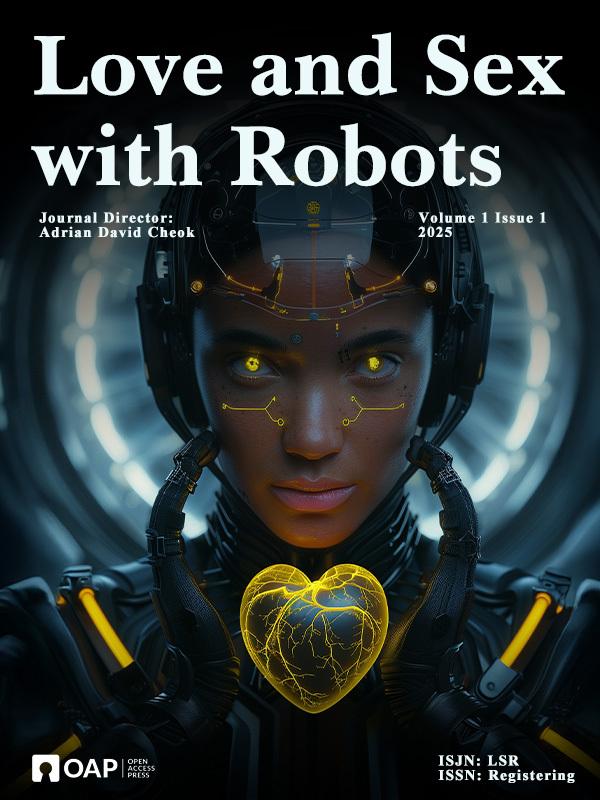
Love and Sex with Robots

Editors-in-Chief



 Aim & Scope
 Volumes & Issues
1. General Requirements
-
Originality:
All submissions must be original, unpublished work, and not currently under review elsewhere. -
Language:
Manuscripts must be written in clear, professional English. American or British spelling and punctuation is acceptable but must be consistent throughout. -
Length:
Regular research articles: approximately 5,000–10,000 words, excluding references and supplementary material. Short communications, reviews, or opinion articles should be about 2,000–4,000 words.
2. Document Format
We strongly encourage authors to use LaTeX for manuscript preparation due to its superior handling of complex mathematical and technical formatting, although Microsoft Word submissions are also acceptable.
-
LaTeX submissions:
-
Use the Article LaTeX template.
-
Submit the manuscript as a single PDF file generated from your compiled LaTeX source.
-
Include all original .tex files and related files (figures, BibTeX references) as supplementary material.
-
-
Word submissions:
-
Use the provided Microsoft Word template.
-
Submit manuscripts in .docx format with clearly indicated headings and structure.
-
3. Manuscript Structure
Ensure the manuscript is clearly structured, with the following sections:
-
Title Page:
-
Title (concise, descriptive, max. 20 words)
-
Authors’ full names, affiliations, and ORCID IDs
-
Corresponding author's name and contact details
-
-
Abstract:
-
Structured abstract (max. 250 words) clearly stating objectives, methods, results, and conclusions.
-
Provide 3–6 keywords.
-
-
Introduction:
-
Clearly establish the background, relevance, objectives, and context of your work.
-
-
Literature Review/Theoretical Background (optional but recommended):
-
Provide a brief synthesis of related literature and theory.
-
-
Methodology:
-
Clearly describe the methods, experimental setups, technologies, procedures, or theoretical frameworks employed.
-
-
Results/Findings:
-
Present data and analyses clearly. Figures, charts, tables, and diagrams should be well-labeled.
-
-
Discussion:
-
Analyze the implications of findings, linking clearly to theory and previous studies.
-
-
Conclusion:
-
Summarize key findings, limitations, and suggestions for future research.
-
-
Acknowledgments (optional):
-
Acknowledge funding, support, or contributions from colleagues who do not qualify as authors.
-
-
References:
-
Use APA or IEEE citation style consistently throughout the manuscript.
-
Bibliographic references should be complete and accurate.
-
-
Supplementary Material (optional):
-
Include additional data, code, multimedia content, or extensive methodological details.
-
4. Figures and Tables
-
Include figures and tables directly within the manuscript in appropriate places.
-
Provide high-resolution figures (minimum 300 dpi).
-
Each figure/table should include a caption clearly describing its content.
-
Figures and tables should be numbered consecutively.
5. Ethical Compliance
-
Research involving human participants or sensitive data must clearly state approval by an ethical review board or committee.
-
Include a statement about informed consent if applicable.
-
For robotics or AI research with societal implications, authors should explicitly discuss ethical considerations.
6. Submission Process
-
Manuscripts must be submitted online through the journal’s manuscript submission system.
-
Authors must register/login to submit their manuscripts and monitor review status.
7. Peer Review Process
-
The journal operates a double-blind peer-review policy. Manuscripts must not contain identifying author information beyond the title page.
8. Post-Acceptance
-
Accepted manuscripts will undergo professional typesetting and formatting.
-
Authors will receive proofs for final corrections.
-
Prompt response (within 3–5 business days) to proofs is required.
📌 Encouragement of LaTeX
Note:
We strongly recommend the use of LaTeX because it facilitates accurate formatting, particularly for complex formulae, equations, algorithms, technical diagrams, and reference management.
For further information, templates, or queries about manuscript preparation, authors are encouraged to contact the Editorial Office or visit the journal website.
Latest Articles
Quick Links
Journal Insights

P-ISSN / E-ISSN

Journal Name (ISJN)
LSR

Founded in
2025

Article Publishing Charge
$1499

Submission to acceptance
45 days

Acceptance to publication
15 days

Acceptance Rate
50%

Publishing Model
Open Access
Contact Us
-
Phone:+44 7546 523855
-
WhatsApp:+44 7546 523855
-
Email:[email protected]
-
QR Code:


