



 Aim & Scope
 Volumes & Issues
1. General Information
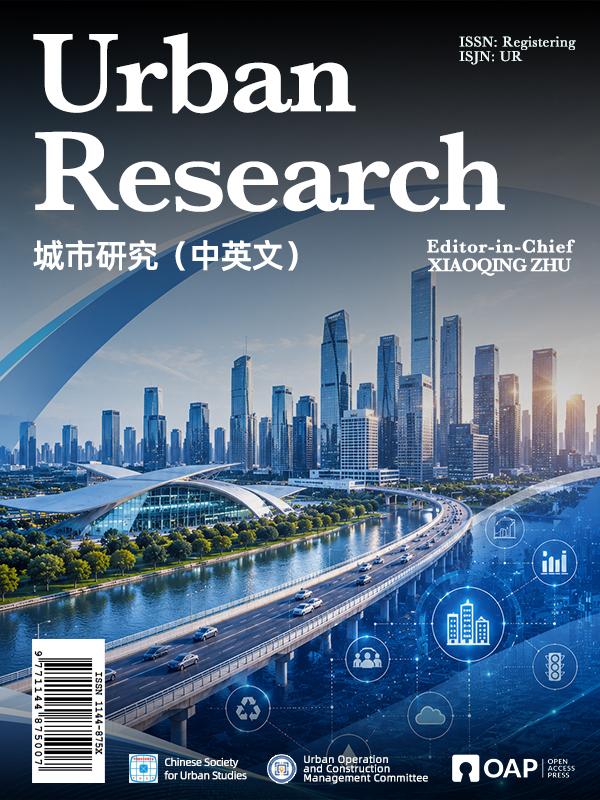
Urban Research is an international open‑access academic journal that publishes high‑quality original contributions across interdisciplinary urban‑related research. All manuscripts submitted to this journal must represent original work that has not been previously published, and is not under consideration for publication elsewhere. Submission implies that all co‑authors have agreed to the submission, and that relevant research ethics requirements have been properly fulfilled.
We accept the following manuscript types:
- Research Articles: Full‑length empirical or theoretical research papers reporting original findings.
- Review Papers: Comprehensive or systematic reviews addressing key frontier topics in urban studies.
- Case Studies: In‑depth analysis of representative urban planning, construction, governance or design practices.
- Short Communications: Concise reports of innovative preliminary results or practical observations.
- Academic Perspectives: Scholarly viewpoints, commentaries and forward‑looking discussions on urban‑related issues.
2. Manuscript Preparation
- Language: All submitted manuscripts should be written in standard academic English. Authors whose native language is not English are strongly advised to have their manuscripts professionally edited for language accuracy before submission.
- Format: Manuscripts should be prepared in editable Word format. Pages shall be numbered consecutively. Figures, tables and captions should be embedded within the manuscript text. High‑resolution image files for figures shall be provided upon request.
- Structure: A complete manuscript should contain: Title page, Abstract (200‑300 words), Keywords (5‑8 items), Introduction, Main text, Conclusion, Acknowledgements (if applicable), References, Tables and Figures.
- Title page: Manuscript title, full names, affiliations, postal addresses and email addresses of all authors; clearly mark the corresponding author.
- References: References should follow consistent academic citation standards. Authors are suggested to adopt APA, Chicago or Elsevier‑style reference format. All cited literature must be traceable. Unpublished works and private communications should be used cautiously.
- Figures & Tables: All figures and tables must be numbered, titled, and cited in the main text. Photos, drawings and charts should have high resolution. Copyright permission is required if re‑using copyrighted visual materials.
3. Submission Process
Authors shall submit manuscripts via the journal’s designated submission system.
- Complete all required metadata in the submission system: manuscript title, author information, affiliations, corresponding‑author contact, manuscript type, keywords, and cover letter.
- The cover letter shall briefly state the originality of the work, confirm no concurrent submission to other journals, and declare any conflicts of interest.
- Upload manuscript file, figure files (if separately required), supplementary materials, and other supporting documents.
- After successful submission, authors will receive a submission confirmation email with a manuscript ID. Please quote this ID in all future correspondence with the editorial office.
4. Peer‑Review Process
All eligible manuscripts will undergo rigorous peer‑review managed by the editorial board. The journal adopts double‑blind peer‑review: reviewers remain anonymous to authors, and authors’ identities are concealed from reviewers. Editors will make publication decisions based on reviewers’ comments, including: Accept, Minor Revision, Major Revision, or Reject. Authors should return revised manuscripts within the time limit specified by the editor. Resubmitted manuscripts should contain a point‑by‑point response letter to reviewer comments.
5. Ethics and Declarations
- Conflict of Interest: Authors must disclose any potential conflicts of interest.
- Authorship: Authorship shall be based on substantial contributions to conception, research implementation, manuscript drafting or revision. Honorary authorship is not permitted.
- Plagiarism: Submitted manuscripts will be checked for plagiarism. Plagiarism, falsification or fabrication of research data will lead to immediate rejection, and may result in further sanctions.
- Copyright & Open‑Access: Upon acceptance, authors retain copyright of their work, and articles are published under an open‑access license (e.g. CC‑BY). Article‑processing charges (APC) shall follow the journal’s official policy.
6. Contact
For submission‑related inquiries, please contact the editorial office via the official journal email.
1. 基本说明
《Urban Research(城市研究)》为国际开放获取学术期刊,刊发城市研究多学科领域高质量原创成果。向本刊投递的稿件须为未公开发表的原创成果,且不得同时投送至其他期刊。投稿即代表全部共同作者同意本次投稿,研究相关伦理要求已得到落实。
本刊接收稿件类型包括:
- 研究论文:报道原创实证或理论研究成果的完整长文;
- 综述论文:围绕城市研究前沿主题开展的综合评述 / 系统综述;
- 案例研究:针对城市规划、建设、治理、设计实践开展深度案例解析;
- 短讯:报道创新性初步研究成果或实践观察的简短文稿;
- 学术观点:针对城市议题的学术评述、观点与前瞻性讨论。
2. 稿件撰写要求
- 语言:投稿全文使用规范学术英文。非英语母语作者建议投稿前完成专业语言润色。
- 格式:稿件使用可编辑 Word 文档,页面连续编号;图、表及图注表注嵌入正文,必要时需单独提供高清图片源文件。
- 文稿结构:完整稿件包含:标题页、摘要(200‑300 词)、关键词(5‑8 个)、引言、正文、结论、致谢(如有)、参考文献、图表。
- 标题页:论文题目、全部作者姓名、单位、通讯地址、邮箱,明确标注通讯作者。
- 参考文献:参考文献采用统一引文格式,推荐使用 APA、Chicago 或 Elsevier 格式,所有引用文献需可溯源;谨慎使用未出版文献与私人通讯。
- 图表:所有图表编号、设置标题,并在正文内对应引用;图片、图表需保证分辨率;使用受版权保护的图片材料需取得版权授权。
3. 投稿流程
作者请通过期刊指定投稿系统完成投稿:
- 在系统填写元数据:论文题目、作者信息、单位、通讯作者联系方式、稿件类型、关键词、投稿信;
- 投稿信简要说明稿件原创性,确认无一稿多投,并说明利益冲突情况;
- 上传稿件文档、图片文件(如需单独提交)、补充材料及其他支撑文件;
- 投稿成功后,作者将收到带稿件编号的确认邮件,后续与编辑部沟通请务必提供稿件编号。
4. 同行评审
符合基本要求的稿件将交由编委会组织严格同行评审,本刊采用双盲评审:审稿人对作者匿名,作者信息对审稿人隐藏。
编辑根据审稿意见给出录用、小修、大修、退稿决定。作者需要在编辑给定期限内返回修改稿,同时提交逐条回复审稿意见的回复信。
5. 学术伦理与声明
- 利益冲突:作者必须披露潜在利益冲突。
- 作者署名:署名仅限于对研究构思、实施、文稿撰写修改有实质贡献的人员,不接受荣誉署名。
- 学术不端检测:稿件将进行查重检测。抄袭、伪造、篡改数据将直接退稿,并可能执行进一步处理。
- 版权与开放获取:稿件录用后作者保留著作权,文章以开放获取协议(如 CC‑BY)发布;文章处理费 APC 遵照期刊官方政策执行。
6. 联系我们
投稿相关疑问,请发送邮件联系期刊编辑部。
Latest Articles

Pathways through which island blue landscape resources enable new-quality cultural tourism: A case study of Cape Park in Daishan County
by Tian Wang, Qinfeng Zhao, Weijun Gao Urban Research Vol. 1 No.1, July, 2026Pathways and Strategic Planning for Coastal Culture–Ecology Integration in Daishan, China
by Yi Yang, Zhixing Li Urban Research Vol. 1 No.1, July, 2026Foreword to Urban Research 城市研究(中英文)创刊词
by Xiaoqing Zhu Urban Research Vol. 1 No.1, July, 2026Quick Links
 Submit an Article
In Partnership with
 Urban Operation and Construction Management Committee
Journal Insights

P-ISSN / E-ISSN
2979-546X

Journal Name (ISJN)
UBRES

Publishing Model
Open Access
Contact Us
-
Phone:+44 7546 523855
-
WhatsApp:+44 7546 523855
-
Email:[email protected]
-
QR Code:


